Adams County, Pennsylvania
Most of the mold in this county lives below the first floor, and almost all of it is a groundwater or humidity problem wearing a different hat.
A basement is cool, it is often the lowest point water can reach, and in much of Adams County it sits inside a foundation that predates modern waterproofing. Stone and rubble foundations move groundwater through the mortar joints rather than blocking it. Even a sound poured wall will sweat when warm humid summer air meets cool concrete and condenses on it.
Then at some point somebody finishes the space. Studs go against the wall, fibreglass insulation goes between them, drywall covers the lot and carpet goes down. Every one of those is an organic or moisture-trapping material placed against a surface that periodically gets wet, with no air movement behind it. That assembly is the single most common mold call we take.
Crawlspaces fail differently. Bare soil releases moisture continuously, vents let humid summer air in to condense on cool surfaces, and nobody goes down there for years at a time. Problems get large before they are noticed.
Basement and crawlspace work throughout Adams County — Gettysburg, Littlestown, New Oxford, McSherrystown, Biglerville, East Berlin, Fairfield and the surrounding townships.
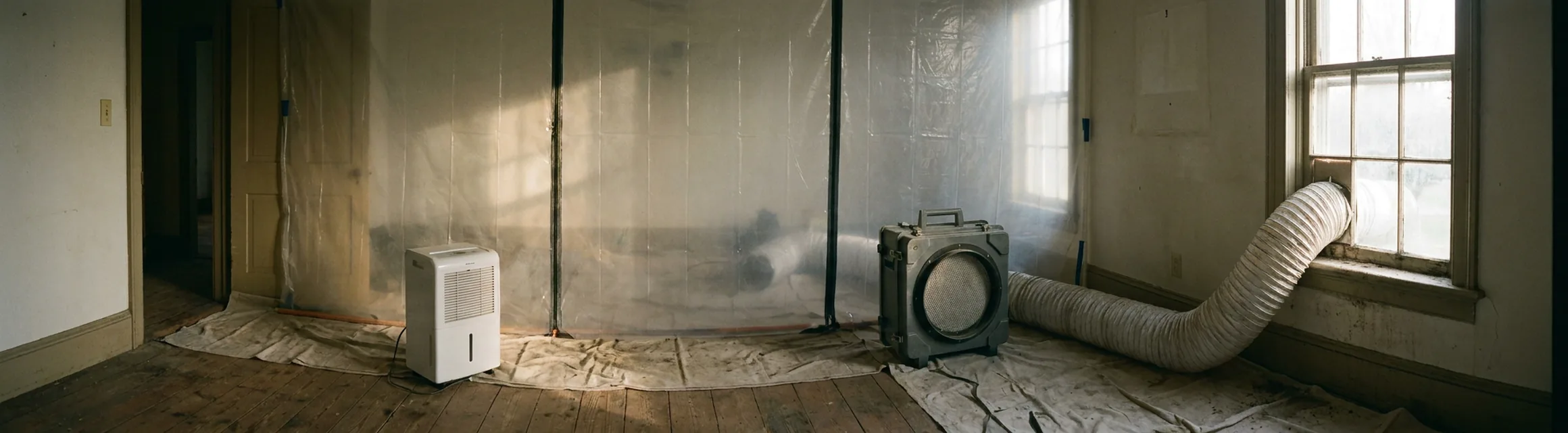
Poly barriers and negative air pressure so removal does not distribute spores through the floors above.
Filtration running throughout the work and after it, not just while the area is open.
Drywall, insulation, carpet and unsalvageable framing come out. Surface-cleaning porous material that has been colonised does not work.
Masonry, concrete and sound framing cleaned and treated rather than removed.
Dehumidification and air movement until moisture readings return to normal for the building — measured, not scheduled.
Grading, downspouts, vapour barriers, sealing and ventilation. Without this the rest is temporary.
Basement and crawlspace work varies more than any other category, because access and the moisture source matter as much as the affected area.
| Factor | Lower cost when | Higher cost when |
|---|---|---|
| Finished or unfinished | Bare foundation walls | Framed, insulated and drywalled |
| Affected material | Non-porous masonry only | Drywall, insulation, carpet, framing |
| Access | Full-height basement, stairs | Low crawlspace, limited entry |
| Moisture source | Downspout or grading fix | Interior drainage or sump work |
| Drying time | Small contained area | Saturated framing and slab |
| Clearance testing | Visual verification | Independent lab sampling |
The single biggest variable is whether the moisture source can be corrected from outside. Regrading and redirecting roof water is inexpensive; interior drainage is a different scale of work. We tell you which one you are looking at before you commit.
An assessment that does not identify the moisture source is not an assessment. Before we quote removal we work out where the water is arriving from, because if that is not corrected the growth returns and you have paid twice.
Cutting into mold without containment turns a localised problem into a whole-house one. Poly barriers, negative air, HEPA filtration and controlled entry go up before anything gets opened.
You get the affected square footage, what is being removed, what is being treated, what drying equipment is going in and how long it stays. If the scope changes once a wall is open, you hear it before the work happens, not on the invoice.
Post-remediation verification — visual, moisture readings, and third-party clearance sampling where the job warrants it. We would rather an independent lab confirm the area cleared than ask you to take our word for it.
Describe the space and its water history. Most of these we can scope accurately from a description and a few photographs.
Moisture mapping and source identification before any scope is written.
Affected area, what comes out, what gets treated, the drying plan and the moisture correction.
Barriers and negative air first, then removal, treatment and drying.
Moisture readings and visual inspection, with independent clearance sampling where the job warrants it.
Often yes — a sealed vapour barrier over the soil, sealed vents and conditioned air usually outperform the older vented approach in this climate. But encapsulating a crawlspace that has an active water entry problem just seals the water in. Correct the water first, then encapsulate.
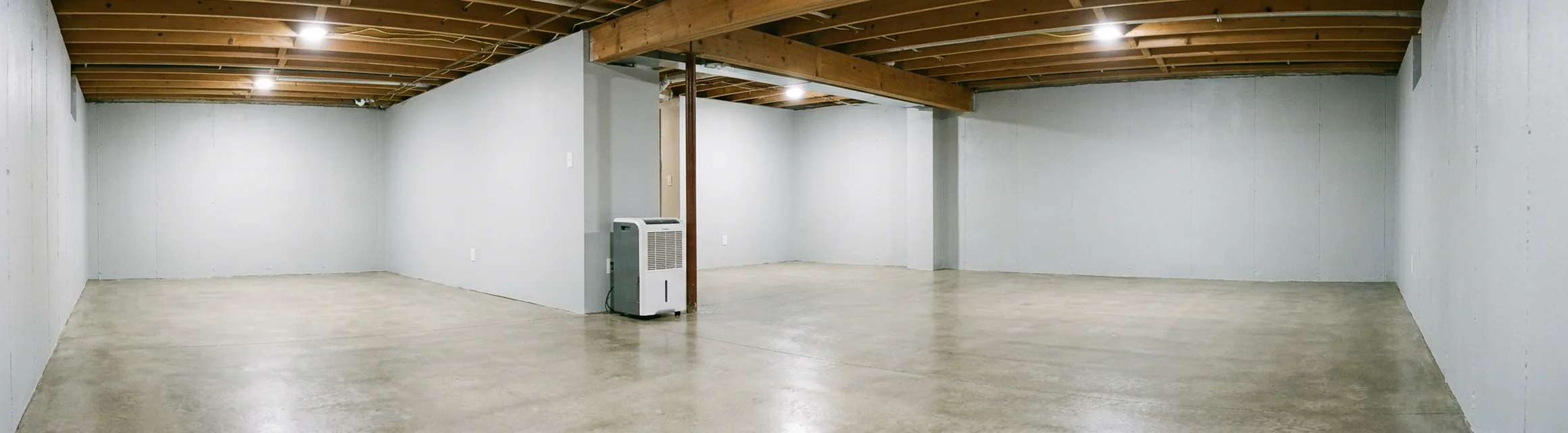
A dehumidifier holding the space below roughly 50 percent relative humidity will stop new growth and is genuinely worth running. It will not remove existing growth from material already colonised, and it will not keep up with liquid water still arriving from outside.
Only if the moisture source is corrected and the framing behind it is sound and dry. New drywall over a wall that still gets wet is the same problem on a delay.
We handle the moisture correction that falls within remediation — grading, downspout routing, vapour barriers, sealing and ventilation. For interior drainage systems or structural foundation work we will tell you plainly that it is a different trade and what to ask them.