Gettysburg, Pennsylvania
An inspection that only confirms what you can already see is not worth paying for. The job is finding where the water is arriving and how far the problem actually extends.
Three things: where the water is coming from, how far the affected area extends beyond what is visible, and what has to be done about it. An inspection that skips the first one is a photograph with an invoice attached — because if the moisture source is not identified, whatever gets removed will simply grow back.
We work with moisture meters, hygrometers and thermal imaging to trace wetting patterns through materials, then open small inspection points where the readings suggest the problem runs behind a finished surface. That is usually how a thirty-square-foot stain turns out to be a four-foot section of wet bottom plate, or how a musty smell with no visible growth turns out to be a crawlspace with no vapour barrier.
Sampling is a separate decision. We recommend it when it will change what you do — not by default.
Inspections across Gettysburg, Cumberland and Straban Townships, Littlestown, New Oxford, Biglerville and the rest of Adams County.
Meter readings across affected and unaffected material to establish where wetting stops — which is what defines the removal boundary.
Temperature differences reveal wet material behind finished surfaces without opening them, so inspection points go where they are useful.
Grading, downspouts, foundation penetrations, plumbing, ventilation and dew-point conditions — the water arrived somehow and that is the finding that matters.
How far the affected area actually runs, including behind and beneath finishes, so the scope is based on the real boundary.
Air or surface samples analysed by an independent laboratory, recommended only where the result changes the decision.
Findings, photographs, readings, the moisture source and a recommended scope — usable for a contractor, an insurer or a sale.
Sampling costs money and does not always change the plan. Here is how we decide, so you can push back if someone recommends it reflexively.
| Situation | Testing usually | Why |
|---|---|---|
| Visible growth, known water source | Not needed | It is getting removed either way; the sample does not change the scope |
| Musty smell, nothing visible | Worth it | Air sampling helps locate a hidden source before you start opening walls |
| Symptoms in the household | Worth it | Tells you what is actually airborne rather than guessing from colour |
| Real estate transaction | Usually needed | Documentation both parties can rely on during negotiation |
| After remediation | Recommended | Independent clearance confirms the area returned to normal |
| Under ~10 sq ft, non-porous | Rarely needed | Often a homeowner clean-up once the moisture is corrected |
We do not mark up laboratory analysis, and clearance sampling after our own remediation is sent to an independent lab. A contractor grading their own homework is a conflict worth avoiding.
An assessment that does not identify the moisture source is not an assessment. Before we quote removal we work out where the water is arriving from, because if that is not corrected the growth returns and you have paid twice.
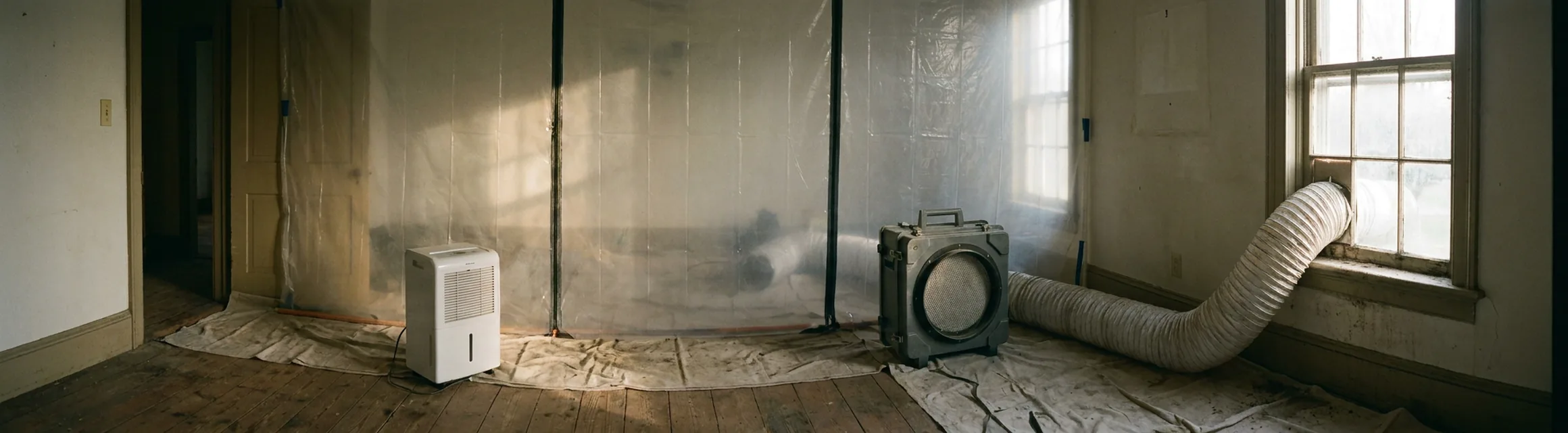
Cutting into mold without containment turns a localised problem into a whole-house one. Poly barriers, negative air, HEPA filtration and controlled entry go up before anything gets opened.
You get the affected square footage, what is being removed, what is being treated, what drying equipment is going in and how long it stays. If the scope changes once a wall is open, you hear it before the work happens, not on the invoice.
Post-remediation verification — visual, moisture readings, and third-party clearance sampling where the job warrants it. We would rather an independent lab confirm the area cleared than ask you to take our word for it.
Tell us what you are seeing and the water history. We will say whether an inspection is the right next step.
Where it is, how long it has been there, and the water history of the building. Photographs help.
Moisture mapping, thermal imaging and inspection points where readings justify them.
Written report with the moisture source, the affected boundary and a recommended course of action.
Remediate, correct the moisture and monitor, or handle it yourself. We are content with any of the three.
No. A free inspection is paid for somewhere, and usually it is paid for by recommending work. We charge for the assessment so the finding is independent of whether you hire us for the remediation.
Yes, and plenty of people use us that way — including to check work another contractor has already done.
A typical single-family assessment runs one to two hours on site. The written report follows within a couple of days, sooner if a transaction is waiting on it.
Sometimes, but a general home inspection is a broad visual survey — it is not a moisture investigation, and it usually will not include meters, imaging or sampling. That is the difference between noticing a stain and establishing what caused it.